Area Method Reactions
Overview
INDUCTA RCB software can be used for calculating the reactions on the walls and columns using the Tributary Floor Area Method. The (Tributary Floor) Area Method mimics hand calculations. RCB distributes the gravity load automatically among the surrounding columns and walls, considering the distance and location of the supporting elements. This method applies appropriate weight fractions proportional to the distance to the supports.
Technical Approach
The algorithm distributes point loads (or columns that transfer at a particular level) to all supporting columns on the floor below, considering the distance between the point load (or transferring column) and each supporting column, as well as the area of slab supported by each column. The following generalised procedure outlines the steps and calculations performed by the software to determine the reactions in the supporting elements using the Area Method.
- Determine the distance between the supporting elements and the load.
- Exclude elements that will have zero (0) reactions due to either a large distance (>15 m) between the load and the support or because they are located within a 'shadow' zone.
- Determine the bisecting angle between the supporting elements and the load.
- Solve the final equation, 'Fi', for the reaction.
- Repeat Steps 1-4 for the next supporting element.
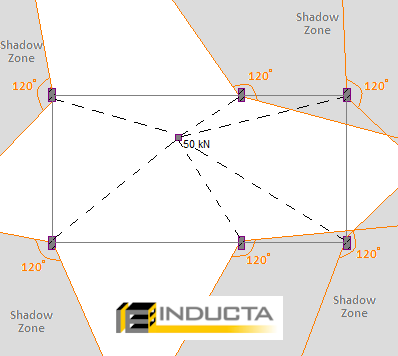
Column and Wall Reactions by Tributary Area